Actualizat: 25-07-2025 / Publicat: 18-04-2017
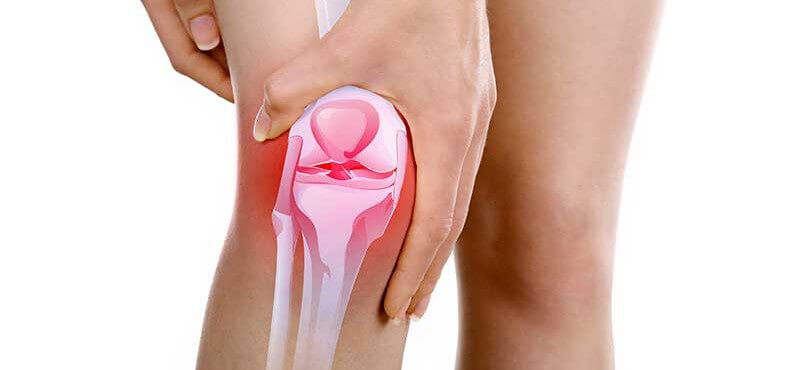
Knee pain – possible conditions and recommended treatment methods
This article was written by
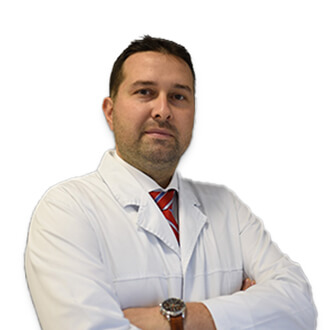
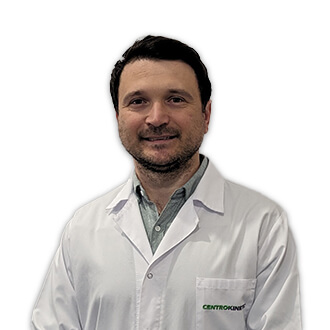
Dr. Andrei Ioan Bogdan, senior orthopedic physician, highly specialized in sports traumatology.
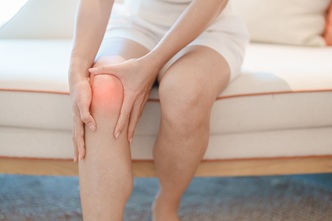
Alongside back pain, knee pain is one of the most common problems among the population. Being a common pain, it can be caused by countless conditions, so a correct diagnosis is crucial in order for the patient to receive the right treatment, one that won't leave room for recurring pain.
The knee joints play a vital role in supporting body weight. This puts pressure on the knees even when you walk, run or jump.
And because knee pain is very common, caused both by intense sports practice and by everyday physical wear, we will tell you what are the best-known conditions that manifest through knee pain, what the symptoms are, how the pain can be treated, and also how you can prevent it.
Symptoms and causes - how to determine the types of knee conditions
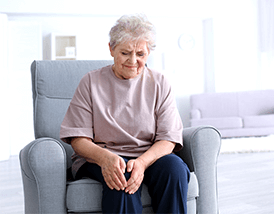
Symptoms vary depending on the specific knee condition. Nevertheless, the things that can be felt externally and that you should pay attention to are pain (especially when bending and straightening the knees) and inflammation.
You need to see a specialist orthopedic physician if you have any of these symptoms:
- You cannot fully extend your leg
- You cannot fully flex your leg
- Walking is painful and you cannot put weight on the affected knee
- The pain persists even when you are not putting stress on the knee
- Redness or a feeling of warmth appears around the knee
- The area below the knee is painful, swollen, numb, or you feel tingling
Common causes of knee pain
Although overuse of the area is the most common cause, knee pain can also be caused by:
- acute injuries: fractures, ligament tears (anterior cruciate ligament, posterior cruciate ligament, medial or lateral collateral ligament), meniscus injuries, patellar tendon or quadriceps tendon injuries, patella conditions, bruises, sprains, dislocations
- chronic injuries: osteoarthritis, degenerative cartilage damage, tendinitis or bursitis.
Other common causes include autoimmune conditions, motor problems, or accumulating excess weight.
We notice that the knee joint is heavily used even in the most trivial activities and, precisely for this reason, is quite sensitive. Therefore, knee pain can have the most diverse causes and can occur at any age.
How do you find out the diagnosis?
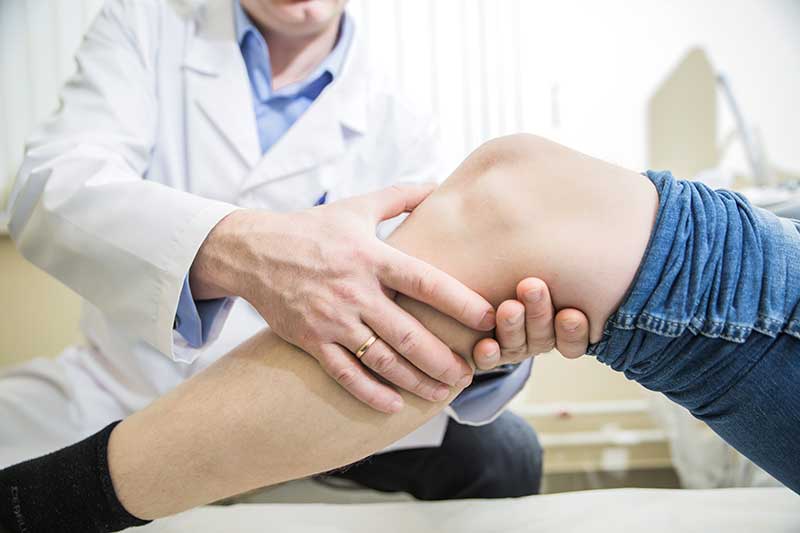
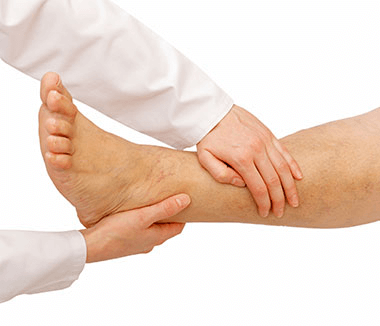
If the pain does not go away after a few days of rest, your knee needs to be examined by a specialist. In order to get a clear diagnosis of what is causing the knee pain, a visit to the doctor is needed, where we will perform a thorough examination - a clinical exam and detailed tests. Most of the time, an imaging exam will also be needed, which, depending on the case, may be: X-ray, ultrasound, MRI or CT scan. The most commonly used paraclinical investigation is the MRI.
![]()
Location of the pain depending on the condition
Most often, the pain manifests as a dull ache, which gradually increases and is associated with physical activity. The location of the pain depends on the affected structure. In addition, the knee can produce various sounds, and the pain appears when climbing stairs or standing up after a long period of rest.
In the case of an isolated meniscus injury or a fracture, the pain has a specific location. In the case of osteoarthritis, however, depending on its degree, the pain occurs localized in one of the compartments of the knee or may be diffuse.
The most common conditions causing knee pain
Knee osteoarthritis
This is the most common condition causing knee pain and covers a group of medical conditions, classified according to symptoms and location:
- Osteoarthritis causes wear of the knee cartilage, leading to damage of the bones in the area
- Rheumatoid arthritis sets in after the immune system has attacked a membrane inside the joint, causing pain, inflammation and damage to the knee tissues
- Gout occurs when uric acid accumulates in the knee, causing sharp, intense pain
- Pseudogout affects the knees after calcium pyrophosphate crystals form in the joint
- Meniscus injury: the medial meniscus is most commonly affected
- Post-traumatic osteoarthritis can develop several years after a knee trauma, such as a bone fracture or damage to a ligament
Meniscus injuries
These are common causes that trigger knee pain. The meniscus is located inside the knee and acts as a shock absorber for the various impacts that can occur during movement. Over time, especially in the case of performance athletes, the meniscus tends to deteriorate and, eventually, to tear. A meniscus tear causes intense, lasting pain, which also occurs during the recovery period, after possible surgery.
Tendinitis
It occurs when the tendons become inflamed, causing strong pain in the knee.
Knee ligament strains
These can also cause pain. These ligaments can be overstretched or torn - most often during intense sports activities. Depending on the type of ligament, its tearing or stretching can cause different kinds of knee pain, as well as instability.
Patella dislocation (kneecap dislocation)
This can cause severe knee pain. This happens when the triangular bone - the one that covers the front of the knee - slides toward the outside of the knee. The dislocation is visible, and the condition is very painful - most often requiring emergency medical attention.
Patellofemoral pain syndrome (runner's knee)
Also called runner's knee, this is a common cause of knee pain. It can be caused by physical overuse, weakening or tightening of the tissues around the knee, or misalignment of the patella.
How do you treat knee pain?
First of all, a correct diagnosis is needed, which is why Centrokinetic pays special attention to this aspect, offering consultations and complete investigations (ultrasound, MRI). For certain knee pains, special medical procedures are needed, such as
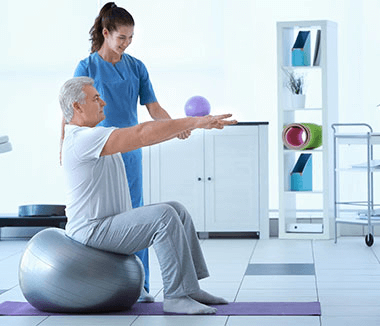
physiotherapy, medical gymnastics or intra-articular injections. Physiotherapy helps the joint, providing it with stability and better mechanical function by strengthening the muscles around the knee.
Intra-articular injections are indicated in well-documented cases and have precise indications. These must be performed by a specialist orthopedic-traumatology physician under sterile conditions.
Surgical treatment may become an option if the pain or instability persists even after physiotherapy treatments carefully supervised by specialists. The procedure can be minimally invasive, such as knee arthroscopy, or laborious and difficult, such as joint replacement.
In most cases where surgery is necessary, medical rehabilitation (physiotherapy and kinetotherapy) are absolutely necessary. Certain conditions also require a rehabilitation protocol before surgery.
![]()
If your knee hurts in a bearable way and you were only able to get a doctor's appointment at the end of the week,
you can speed up healing or at least eliminate the pain through a series of measures you can take right at home: - Rest your knees and avoid any intense physical activity
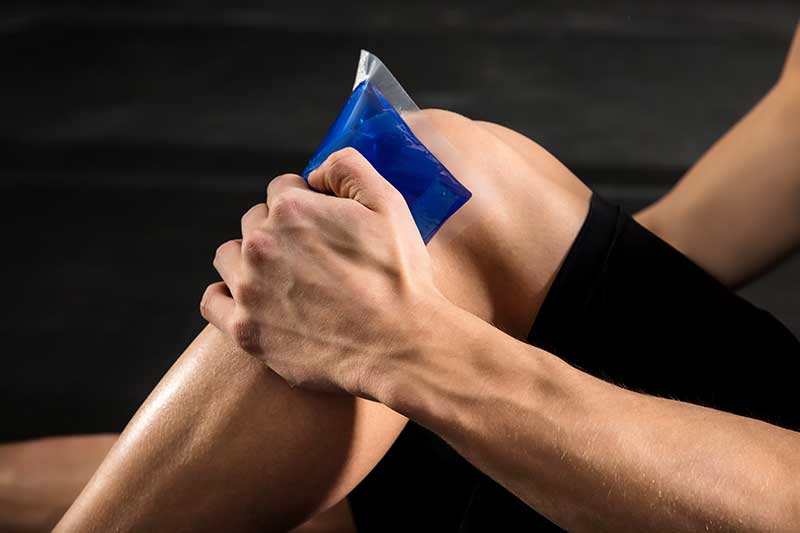
- Put ice on the knee to reduce pain and inflammation, at least 20-30 minutes every 3-4 hours, for 2-3 days or until the pain goes away
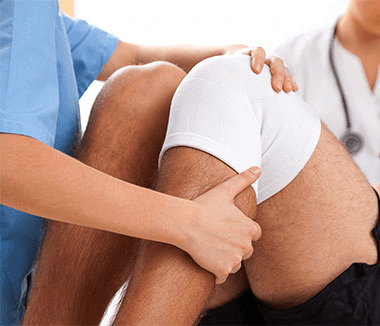
- Use knee wraps - an elastic bandage to provide support to the affected joint, but also to avoid swelling.
- Elevate the knee with the help of a pillow while sitting or lying down, to reduce swelling.
Recovery time for knee pain
Recovery time for knee pain depends on the condition that is bothering you. Also,
people heal at their own pace, over different periods of time.
Whatever you do, don't rush things. Returning to your previous level of physical activity should be done slowly, going back to your usual routine only once you no longer feel any pain in the knee when bending, walking or jogging lightly. If you overload it before it is fully healed, you risk causing yourself permanent damage.
As the condition improves, ask your doctor what new activity they recommend to help the joint heal slowly and healthily. For example, runners could try swimming.
Prevention of knee pain
Knee pain is hard to prevent, as accidents are their main cause. However, there are some precautionary measures you can consider to reduce the risk of an injury:
- Never continue the exercise if you feel pain in your knees
- Gradually increase the intensity of your workouts
- Don't forget to stretch after physical activity
- Keep your thigh muscles strong through strengthening exercise
- Warm up your muscles before physical exertion
Being a complex joint, on which a multitude of natural movements depend, it is very important not to delay treatment if you notice that the pain persists even after a period of rest.
YOU CAN BOOK AN APPOINTMENT HERE for a consultation, an MRI or medical rehabilitation. At Centrokinetic, the best doctors and therapists are available for any joint or musculoskeletal problem, from the initial consultation and complete investigations within the clinic, to treatment and complete medical rehabilitation for spinal, traumatic or post-surgical conditions. Centrokinetic is the place where you will find answers and clear solutions for your mobility problems. The clinic dedicated to bone and joint conditions is divided into the following specialized departments:
- Orthopedics, a department made up of a highly experienced team of orthopedic surgeons, led by Dr. Andrei Ioan Bogdan, senior physician in orthopedics-traumatology, with surgical activity at the Medlife Orthopedic Hospital, specialized in sports traumatology and in ankle and foot surgery.
- Pediatric orthopedics, where children's sports injuries are treated (ligament and meniscus injuries), spinal deformities (scoliosis, kyphosis, hyperlordosis) and foot conditions (hallux valgus, hallux rigidus, clubfoot, flat valgus foot, cavus foot).
- Neurology, which has a state-of-the-art department, where consultations, electroencephalograms (EEG) and electromyograms (EMG) are performed.
- Medical rehabilitation for adults and children, a department specialized in the recovery of performance athletes, in spinal conditions, and in the recovery of children with neurological and traumatic conditions. Our experience is extremely rich, having treated over 5000 performance athletes.
- Medical imaging, the clinic being equipped with ultrasound and MRI, high-performance devices dedicated to musculoskeletal conditions, and complemented by an experienced team of radiologists: Dr. Sorin Ghiea and Dr. Cosmin Pantu, specialized in musculoskeletal imaging.
Find out the latest news by following the Facebook and YouTube accounts of the Centrokinetic clinic.