Plagiocephaly


What is plagiocephaly, why it occurs, and how it can be treated

Plagiocephaly is the medical term for an asymmetrical, flattened shape of a baby's head. In this article, you can find out what causes plagiocephaly, how it can be prevented, and what the treatment options are.
- What is plagiocephaly?
- Types of plagiocephaly
- What causes plagiocephaly?
- Sleep position
- Insufficient time spent on the tummy
- Twin pregnancies
- Premature birth
- Forceps or vacuum delivery
- Muscular torticollis
- Plagiocephaly - symptoms
- Plagiocephaly - complications
- Plagiocephaly - treatment
- Correcting the sleep position
- Kinesiotherapy
- Helmet for plagiocephaly
What is plagiocephaly?
Plagiocephaly is a condition in which the baby's head appears asymmetrical. Instead of a rounded shape, the skull is simply flattened on one side. A more telling description is one that says that, viewed from above, the baby's head fits into a parallelogram shape.
The bones of the skull are flexible and not fully fused at birth - which is essential so the little one can pass through the birth canal during delivery. In addition, the soft, flexible bones provide room for brain growth, which is remarkable during the first year of life.
But because of these flexible bones, the shape of a baby's head can also be influenced by external factors. And one of the most common causes - though not the only one - of skull deformation is spending time in the same position.
Given the specific nature of the condition, plagiocephaly in adults is rarely discussed. In these cases, it is more likely to be severe forms of congenital plagiocephaly that could not be corrected.

Types of plagiocephaly
According to specialists, there are two main types of plagiocephaly: positional and congenital.
- Positional plagiocephaly is the most common form of this syndrome. The American Academy of Family Physicians states that positional plagiocephaly affects up to 50% of babies;
- Congenital plagiocephaly is also known as craniosynostosis and is a rare congenital anomaly. In babies who suffer from this condition, the fibrous spaces between the skull bones close prematurely, which causes the head to become deformed. According to statistics, congenital plagiocephaly occurs with a frequency of 1 in 2000 - 2500 births.
Depending on the area where the skull deformation occurs, doctors use a more detailed classification of cranial deformities:
- Plagiocephaly is the term considered appropriate for oblique flattening of the head;
- Brachycephaly is the term used when the head is flattened at the back;
- Scaphocephaly is the term for bilateral parietal flattening of the head.
It is important to remember that some cranial deformities, especially congenital ones, are also accompanied by facial asymmetry, and that anomalies in the shape of the skull can be symmetrical or asymmetrical.
What causes plagiocephaly?
Congenital plagiocephaly often appears as an intrauterine developmental anomaly; some cases may be the result of a genetic inheritance, appearing to manifest in several members of the same family. There are over 180 rare syndromes that can be accompanied by plagiocephaly.
Positional plagiocephaly has several possible causes:
- sleep position;
- insufficient time spent on the tummy;
- twin pregnancies;
- premature birth;
- forceps or vacuum delivery;
- muscular torticollis.
Sleep position
Babies sleep a great deal, compared to the amount of sleep an adult needs. When, during sleep, the baby is placed in the same position every day - for example, on their back, but with their head always turned to the right or to the left - a certain area of the head is constantly exposed to pressure.
The highest risk of positional plagiocephaly occurs in the first four months of the baby's life, before they learn to roll over on their own. Although this risk of plagiocephaly exists, doctors' recommendation is that babies always be put to sleep on their backs to reduce the risk of sudden infant death syndrome.
Insufficient time spent on the tummy
The more time a baby spends lying on their back, the greater the risk of developing plagiocephaly. Time spent on the tummy, when the little one is awake and under the close supervision of an adult, is essential for their development and for preventing a deformed head in babies.
Some babies cry when placed on their tummy, but that shouldn't discourage you. To avoid protests, get their attention with toys, or lie on your back and place them tummy-down on your chest. As the muscular strength of the neck and back increases, the little one will become more and more delighted with this position.
Twin pregnancies
In the case of a twin pregnancy, the intrauterine space is smaller than normal, and the risk of compression of the skull bones is, naturally, higher. Sometimes, plagiocephaly can occur in twins as a result of this. In rare cases, depending on how the pressure manifests, bumps on the head can appear in babies.
Premature birth
In premature babies, the skull bones are even softer than in babies born at term. Moreover, the specific care given to very young premature babies means that they are handled fairly little and spend a lot of time in the same position - on their backs.
For these two reasons, plagiocephaly is much more common in premature babies than in babies born at term.
Forceps or vacuum delivery
In deliveries where the use of forceps or a vacuum device is necessary, pressure is applied to the baby's skull, which can cause a temporary deformation of it. Most often, however, an elongated head shape appears in babies born this way.
Muscular torticollis
Torticollis is a muscular condition in which the muscles in the baby's neck are stiff, or there is a muscle contracture in a single muscle group. Torticollis is more common than people think and is caused by limited space in the uterus or by a breech presentation.
Plagiocephaly - symptoms
Plagiocephaly is not always easy to identify, especially since, in some cases, it can take several months before it becomes apparent. The head deformation is most easily noticed during bath time, when the hair is wet.
The most common symptoms are:
- the appearance of a flattened area on one side or the other of the head, or at the back of the head;
- an asymmetry of the ears, when one ear appears positioned higher than the other;
- the appearance of a hairless area on the scalp;
- absence of the fontanelle.
Diagnosing plagiocephaly is simple and straightforward. In some cases, however, additional investigations may be needed to detect a possible rare syndrome that may also have plagiocephaly as a symptom.
Plagiocephaly - complications
Positional plagiocephaly is generally considered an aesthetic issue, not a medical one. In the vast majority of cases, it does not affect the way the brain develops, and the shape of the skull frequently corrects itself as the child grows and becomes much more mobile. A pediatric consultation can assess the severity of the deformation.
There is a study conducted in 2004 during which the head circumference of 200 babies was regularly measured, from birth until they turned 2 years old. In their case, the incidence of positional plagiocephaly evolved as follows:
- 16% at 6 weeks;
- 19.7% at 4 months;
- 6.8% at 12 months;
- 3.3% at 24 months.
Permanent deformities of the skull are rare, subtle, and very well hidden by the hair.
In the case of congenital plagiocephaly, when the bone sutures close prematurely, surgery relieves pressure on the brain and allows it to grow normally. Surgery also reduces the risk of:
- developmental delay;
- blindness;
- seizures;
- other medical problems.
Plagiocephaly - treatment
Treatment for plagiocephaly depends on the severity of the condition and its possible cause. It may involve:
Correcting the sleep position
Sleeping on the back is still the safest way to prevent sudden infant death syndrome in babies. If the baby seems to prefer falling asleep facing left, make sure to position them more often facing right.
Most of the time, the baby's crib is placed next to a wall; if not, one area of the room is always more interesting than the other. To prevent the little one from keeping their head turned too much in one direction, lay them down alternately with their head toward one end of the crib or the other, so that, in order to look at the area of interest, they are forced to turn sometimes to the left, sometimes to the right.
Kinesiotherapy
If the baby has torticollis, stretching exercises and massage can help increase the range of motion of the neck. Given how delicate babies are and how important and sensitive the neck area is, it is strictly forbidden to do stretching exercises at home; they must always be handled by a specialist.
Helmet for plagiocephaly
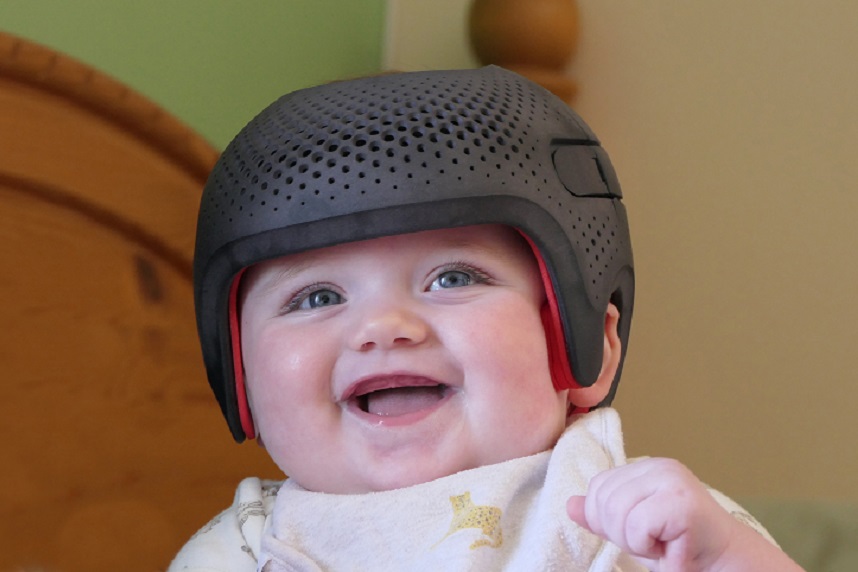
This type of therapy involves the baby wearing a helmet specially designed for them, which helps reshape the skull into a symmetrical/normal shape. According to the American Association of Neurological Surgeons, the optimal age for wearing a plagiocephaly helmet is between 3 and 6 months, but up to 12 weeks may be needed to achieve the desired result. These recommendations are consistent with the earlier information about the age up to which a baby's head can still be reshaped.
The helmet is reserved for moderate and severe cases of plagiocephaly and is used only on the specialist's recommendation. It must be worn 24/7, except during the child's daily bath. Naturally, the helmet can cause local irritation and can bother the baby, which is why it is a good idea to talk to the doctor and weigh the possible advantages against the definite disadvantages of this method.
Plagiocephaly, in its mild form, is common in babies and tends to heal on its own, as the little ones become more and more mobile. Positional plagiocephaly does not affect the baby's development and does not require mandatory medical intervention, but rather careful monitoring and the identification and removal of possible causes.
Centrokinetic is the place where you will find clear answers and effective solutions for musculoskeletal conditions. Our clinic, dedicated to musculoskeletal disorders, is organized into the following specialized departments: Stay up to date by following Centrokinetic on Facebook, Instagram, and YouTube.
MAKE AN APPOINTMENT
FOR AN EXAMINATION
See here how you can make an appointment and the location of our clinics.
MAKE AN APPOINTMENT
BUCHAREST TEAM






















































CLUJ NAPOCA TEAM






























BRASOV TEAM
















Asiguratori privati





Parteneriate



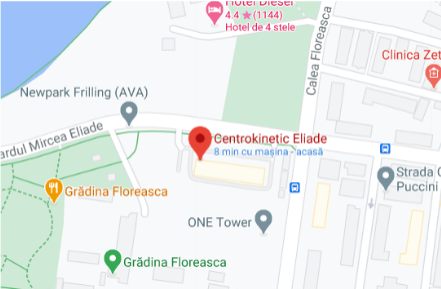
CENTROKINETIC FLOREASCA
Bucharest, 1st District,
Mircea Eliade Street, no. 18,
Eliade Tower, Entrance A, Floor 3
| Navigation | Explore 3D |
CENTROKINETIC Barbu Vacarescu
Bucharest, 2nd District,
Barbu Vacarescu Street, no. 102,
102 The Address, ground floor.

| Navigation | Explore 3D |
CENTROKINETIC MILITARI
Bucuresti, Sector 6,
Bld. Iuliu Maniu, nr. 15G,
Cladirea PBT, etaj 3.

| Navigation |

CENTROKINETIC CLUJ-NAPOCA
Cluj-Napoca,
Str. Intre Lacuri, nr.1
Intrarea este in spatele cladirii.

| Navigation |
SOCRATES CLINIC TIMISOARA
Timisoara, Calea Martirilor 1989,
nr. 1.
Telefon: 0371 785 374.

| Navigation |
CONTACT
Phone: 0319693
E-mail: programari@centrokinetic.ro
Operating hours:
Monday – Friday: 07:00 – 21:00
Saturday: 09:00 – 14:00
Sunday: closed.
MAKE AN APPOINTMENT