Actualizat: 30-08-2025 / Publicat: 24-06-2019
During the adolescent growth spurt, weakening of the upper femoral growth cartilage and stress due to an increased body mass index can cause the upper femoral epiphysis to slip and become displaced from its normal position relative to the femoral neck. Usually, the femoral neck slips anteriorly and superiorly relative to the epiphysis, which remains in a normal position relative to the acetabulum. The condition can be bilateral, developing simultaneously or successively.
The condition can have a gradual, insidious onset, can be acute, with sudden onset, or can become acute after a period with relatively mild symptoms.
It occurs predominantly in boys, generally after the age of 11, during the period of maximum bone growth, more frequently affecting the left hip.
Signs and symptoms
Pain and limping, with a rapid loss of support on the affected leg. Clinically, internal rotation of the thigh is limited or even impossible. Without treatment, the femoral head heals improperly, permanently fixing the leg in external rotation.
a) Temporal – according to the time elapsed since the onset of symptoms
- Acute – pain appeared less than 3 weeks ago, usually after minor trauma
- Chronic – moderate pain radiating to the thigh and knee that persists for more than 3 weeks
- Acute on chronic – painful symptoms older than 3 weeks with sudden worsening of the pain
b) Functional
- Stable – the patient can bear weight on the affected leg
- Unstable – the patient cannot bear weight on the affected leg
c) Morphological – according to the Southwick angle
- Mild – up to 30 degrees
- Moderate – between 30-60 degrees
- Severe – over 60 degrees
In most cases, the cause of slipped capital femoral epiphysis is not elucidated, but mechanical, endocrine, and genetic factors are implicated.
Differential diagnosis. This is made with:
- Transient synovitis of the hip – where symptoms last at most 10 days;
- Legg-Calve-Perthes disease – where the radiological examination does not show slippage of the femoral head
- trauma
- arthritis
The main objective in the treatment of slipped capital femoral epiphysis is to stabilize the upper femoral epiphysis on the femoral neck and to prevent further slippage.
Therapeutic alternatives are in situ percutaneous internal fixation of the femoral head epiphysis, epiphysiodesis with bone graft, cephalic repositioning, and cervical, intertrochanteric, or subtrochanteric osteotomies.
Complications Avascular necrosis of the femoral head – caused by the particularities of the blood supply of the femoral head
Chondrolysis – painful hip stiffness
What does Centrokinetic offer you if you suspect you have Slipped Capital Femoral Epiphysis?
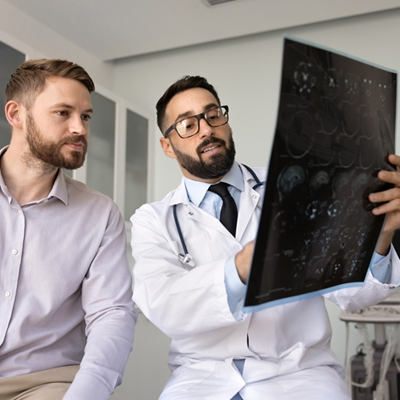
• a correct diagnosis through a medical clinical examination and imaging investigations
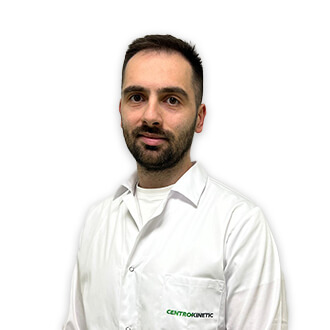
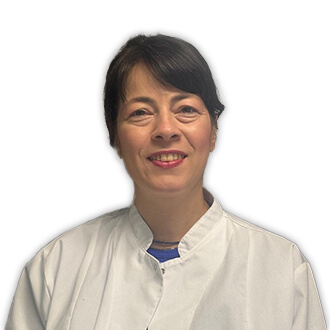
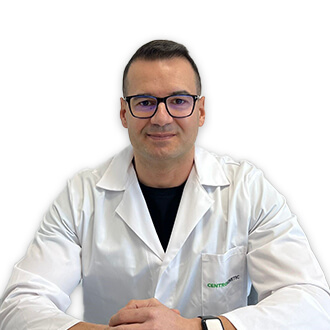
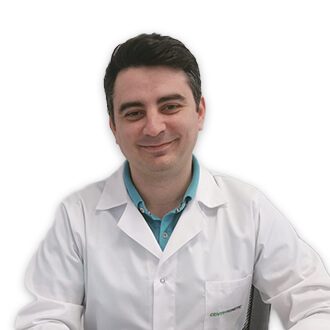
• a highly specialized team
• proper coordination, with children or adults able to benefit from consultations in neurology, orthopedics, and medical recovery.
IF YOU DON'T ALREADY KNOW US
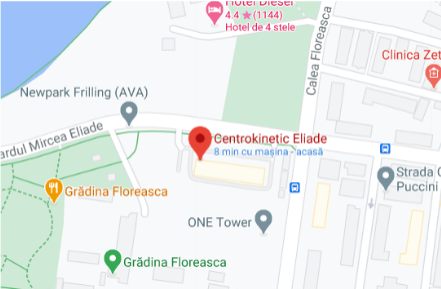
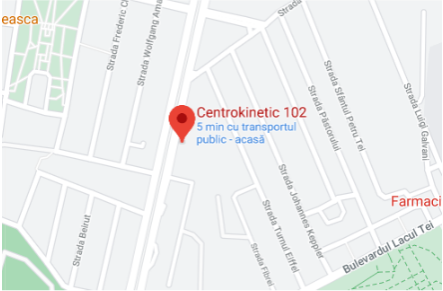
Centrokinetic is the most advanced medical clinic dedicated to osteoarticular conditions, organized into several dedicated departments:
- Orthopedics: made up of a highly experienced team of orthopedic doctors, led by Dr. Andrei Ioan Bogdan, senior physician in orthopedics-traumatology with surgical activity at Floreasca Emergency Clinical Hospital and at Medlife Orthopedic Hospital, specialized in sports traumatology and in ankle and foot surgery.
- Pediatric orthopedics, where we treat children's sports conditions (ligament and meniscus injuries), spinal deformities (scoliosis, kyphosis, hyperlordosis), and foot deformities (hallux valgus, hallux rigidus, clubfoot, flat valgus foot, cavus foot).
- Neurology, performing consultations and EMG within the department. The medical team is completed by dr. Mardare, who specialized further at the University of Oxford in spinal surgery.
- Medical recovery, for children and adults, the department being led by one of the most experienced doctors in the field, senior lecturer dr. Tache Georgiana. The department specializes in the recovery of performance athletes, in spinal conditions, in the recovery of children with neurological and traumatic conditions.
- Medical imaging, the clinic being equipped with ultrasound and MRI, dedicated to musculoskeletal conditions. We are proud of our medical team of radiologists, made up of dr. Ghiea Sorin, dr. Pantu Cosmin, dr. Florescu Nicoleta, specialized in musculoskeletal imaging.
Find out the latest news about us by following the Facebook and YouTube accounts of Centrokinetic clinic.