Actualizat: 18-03-2025 / Publicat: 22-05-2018
What grafts are used in ACL reconstruction surgery
There are three types of grafts. Grafts can be harvested from the same patient, in which case they are called autografts, or we can harvest them from another patient, from the tissue and bone bank, these being called allografts, or artificial grafts can be used.
In over 95% of cases, the grafts are from the same patient, that is, autografts. These are the best because they integrate the fastest and it is the safest method of intervention.
We can talk about 3 harvest sites from the same patient:
- The semitendinosus and Gracilis muscles, known as hamstrings (in most cases)
- The quadriceps tendon, practically the final part of the quadriceps muscle
- The patellar tendon
What are the most commonly used ligamentoplasty techniques
The patellar tendon was the first solution used, in the history of this type of surgery. These operations had a fairly high success rate, but the complication rate was also increased, and these could appear up to two years after the intervention. Usually, this type of intervention was associated with pain in the lower part of the knee, as well as the patient's inability to kneel or to do squats or lunges for a very long time.
Subsequently, this technique was developed further, using the semitendinosus and Gracilis muscles. It is a less invasive, faster technique, but at the same time, a technique that requires much more rest on the part of the patient, in order to resume sports activity. Whereas with the patellar ligament, the patient can return to sports activity after about 5-6 months, with soft-tissue ligamentoplasty, practically with hamstrings, the patient must wait, according to new studies, up to 9 months, even 12 months.
More recently, the technique using the quadriceps tendon has appeared. Apparently, this is a more invasive technique due to a larger incision. However, new methods and instruments have emerged, through which we can harvest this tendon through a very small incision, of only 2 cm.
This is also the method currently used by Dr. Andrei Ioan Bogdan, especially in the case of revisions, while as a first choice he uses the hamstring graft. It involves a fairly simple, quick harvesting method, in which we use two muscles, the Gracilis and the semitendinosus, which we can use in numerous ways to prepare the graft.
Advantages and disadvantages of screws for graft fixation
The ligamentoplasty technique has changed in recent years. We now use an all-inside technique. In itself, this technique means we do not use screws to fix the graft, since everything we are discussing comes down to how the graft is fixed.
To give a brief history, titanium screws appeared first, and they were a very good fixation method. However, this technique required another surgical intervention after a period of time, more precisely after one year, in which these screws had to be removed.
Subsequently, bioabsorbable screws appeared, which brought an enormous advantage to this technique. Over time, however, it was shown that during the resorption process, these screws could generate cysts in the bone structures, cysts that represent a complication of ligamentoplasty.
More recently, bioinductive screws have appeared. These undergo a process that takes, on average, 2 years, through which they turn into bone tissue. In turn, they represented an enormous advance in terms of ligamentoplasty, but here too, perhaps in the case of one patient in 100, arthritis of the knee may occur, more precisely the patient feels the knee swollen for quite a long period, of several months. All the inflammatory markers are disrupted, and progress in the recovery process is very, very slow.
That is why the newest screws are bioinert screws. These do not resorb, but they also do not react with the surrounding tissues. Practically, there is no complication that can occur after ligamentoplasty.
At the same time, fixation methods using extra-articular buttons have also been developed. Special threads are attached to these buttons, which are very small (1 cm long / 1 mm wide), and are used to fix the graft to the bone.
What all-inside ligamentoplasty involves
The all-inside technique involves the use of 2 such buttons. One is placed on the femur, the other on the tibia. This is how the graft is fixed. After this graft is harvested, a colleague from the surgical team begins to prepare it. The muscle portion is removed, and the remaining tendons are fixed, with the two buttons attached to them.
The next step is a thorough investigation of the joint, in which we must observe whether there are injuries to the menisci, cartilage, or collateral ligaments. If such injuries are also present, they must be addressed during the same surgical stage.
MRIs and preoperative investigations are useful so that the team knows in advance exactly what needs to be done and whether there are injuries to be addressed before the operation. Nevertheless, the joint still needs to be examined in detail, since sometimes even the radiologist may miss certain details.
If the patient does not have these injuries, or after they have been repaired, the ligamentoplasty itself begins, in which we must create the two tunnels, femoral and tibial. The difference, in the case of this medical technique, is that the tibial tunnel is created in a different way, practically, from inside the joint toward the outside.
Subsequently, the graft is pulled into the joint and fixed with the two buttons. The degree of tension of the graft is checked, both in maximum flexion and in maximum extension. At this point we must make sure that the patient has full mobility, and that the graft is equally tensioned throughout the entire range of motion.
![recuperare operatie reconstructie ligament incrucisat anterior]()
How long recovery takes after ligamentoplasty
Ligamentoplasty is a fairly laborious intervention, but it is fairly standardized nowadays. Ligamentoplasty takes around 40-50 minutes, so we can consider it a quick intervention, which reintegrates the patient professionally, within the family, and socially fairly quickly, after about 2-3 days. Office work is allowed after approximately 6 days, and field work after 6 weeks. But this recovery process takes on average between 6-12 months. Current studies show that the patient no longer feels that they were operated on after 18 months, on average.
What patients may feel in the knee after ligamentoplasty
Practically, you should expect that after this surgical intervention, in the first 2 years, you will feel all kinds of sensations in the knee. The most frequently reported sensation is a feeling of the knee joint locking, which occurs in the first 4-5 months.
More precisely, when the patient performs a maximum flexion, upon returning to extension, they feel that something is blocking this movement, and sometimes they have to repeat this movement several times, in order to have normal mobility. After giving up this movement for half an hour or an hour, resuming flexion and extension is again done with difficulty. This is a normal process, do not be alarmed, I receive many questions related to this sensation. It is caused by the fact that, normally, we have synovial fluid in the joint, secreted by the synovial membrane.
To draw an analogy, this synovial fluid is like an oil. And this oil is lost during the surgical intervention, which involves continuous washing of the joint, during the intervention, with 6-7 liters of saline solution. In order to perform the surgical intervention, we remove part of the synovial membrane, to create enough room to carry out the intervention.
Ligamentoplasty with synthetic graft. Who it is for and how it is done
The second fixation method, or ligamentoplasty method, is with a synthetic graft. It is generally intended for performance athletes. The synthetic graft resembles a shoelace. It is an extremely solid graft, which does not tear unless the postoperative patient suffers an extremely intense trauma.
As I mentioned, the synthetic graft is intended for performance athletes, because, after a certain amount of time, it will invariably tear. The synthetic graft is guaranteed by the manufacturer for between 10-15 years, depending on the patient's level of activity.
For a person who does not engage in performance sports, the synthetic graft is not recommended, because nowadays ligamentoplasty can generate the ligament naturally for them. For a performance athlete, this graft is appropriate, because the risk of recurrence is low. The vast majority of athletes have a limited career, and if they undergo a ligamentoplasty and suffer a failure in the first 9 months, a revision of the surgical intervention means losing another 9 months. So, if a recurrence occurs, the athlete can lose approximately 2 years of their career, a career that lasts 15 years, on average.
The role of regenerative therapies after ligamentoplasty
I recommend that all patients undergo regenerative therapies after ligamentoplasty. Practically, this involves an autotransfusion of blood, which is performed at one month, two months, and three months, using the patient's own blood. It is a procedure that takes on average between 15 and 20 minutes, and is simple and painless.
The platelets harvested at the joint contain the natural regeneration factors. These factors produce faster integration of the graft and a physiological regeneration of the joint.
The recovery process is essential after ligamentoplasty
After ligamentoplasty, the recovery process is very important. Whenever you need such an operation, you must know from the start what the intervention involves and what the recovery process involves. If you do not do these two things, if you are not aware of them and do not carry the recovery program through to the end, the ligamentoplasty operation will not end in success. You will be left with certain muscular deficiencies, in flexion and extension, and there will be many activities in your life that you will not be able to do, or at least not at maximum capacity.
When recovery begins after anterior cruciate ligament reconstruction surgery
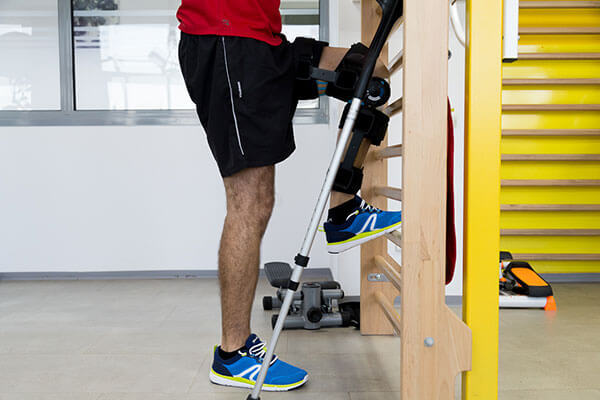
The recovery process begins the day after the anterior cruciate ligament reconstruction intervention, in the hospital, with flexion up to 70 degrees and many other exercises, and the patient can bear weight up to 50% of their body weight.
Subsequently, in a specialized facility, with a physical therapist, you must begin around the 3rd or 4th day, with specific exercises, following a certain staged progression. Progress should occur as follows:
- At approximately 2 weeks after ligamentoplasty, the patient gives up the crutch on the operated side
- At 3 weeks – one month, the patient gives up the second crutch.
Normally, immediately after the operation a brace is fitted, whose role is to over-stabilize the knee and to protect against certain abnormal movements, which can generate complications of the surgical intervention. This is normally given up after about a month.
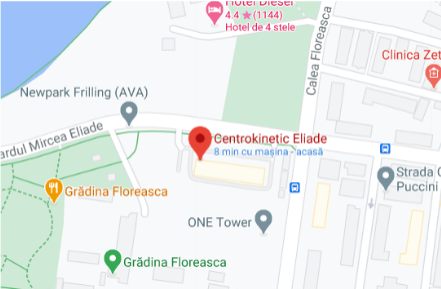
If you have undergone such a surgical intervention, to make sure that you have a correct and complete recovery process, we are waiting for you at Centrokinetic recovery clinic, alongside our specialists, who can offer you training, based on international recovery protocols, because all the recovery work we do is drawn from major European clinics and is based on very well standardized protocols. Thus, although each patient recovers at their own pace, regardless of their individual progress, we can say that after 3-4 months all patients reach the same excellent level overall.